
How to remove pigmentation spots on the hands?
Updated: Oct 11
Pigment spots on the hands can have different causes. Laser lightening is one option for certain benign spots; their nature and the condition of the skin should be assessed before treatment.
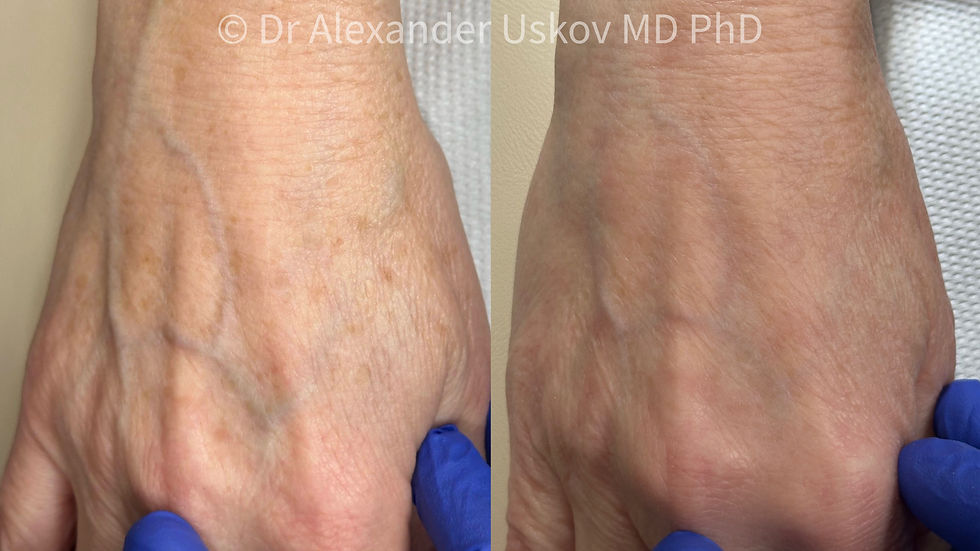
Photographs help compare skin colour and texture. Assessing the result also requires treatment and follow-up information; an image alone cannot confirm a diagnosis or show every possible complication.

Why pigment spots appear on the hands
Sun exposure can contribute to solar lentigines on exposed areas, including the backs of the hands. However, not every brown spot is caused only by age or sunlight.
If the appearance of spots bothers you, you can discuss correction with a doctor. Diagnosis comes first: different skin changes can look similar and require different approaches.
When laser treatment is considered
Laser treatment can reduce the visibility of some diagnosed benign pigmented spots. Post-inflammatory pigmentation requires a different approach; laser treatment is not suitable in every case and may worsen darkening.
Options and limitations
Pigment targeting: the choice of technology depends on the diagnosis, skin phototype and characteristics of the spot.
Risks: skin injury, colour changes and scarring can occur; freedom from tissue damage cannot be guaranteed.
Different causes: solar lentigines and post-inflammatory pigmentation need separate assessment.
Treatment goal: reducing the visibility of spots; rejuvenation and collagen stimulation are not guaranteed effects of every pigment laser.
What to discuss at the consultation
1. Diagnosis
The doctor examines the spots and asks when they appeared and how they have changed. Dermoscopy and other investigations are used when indicated; a Wood's lamp does not replace diagnosis. A suspicious or uncertain lesion needs diagnostic assessment before cosmetic removal.
2. Choosing a procedure
The method and need for treatment are assessed after examination. Complete removal in one session cannot be promised. Session count and intervals depend on the diagnosis, method and skin response. Pain or discomfort can occur; pain relief is discussed individually.
3. Care after treatment
The doctor explains care for the treated skin and sun protection. Additional products are selected when needed, rather than prescribed universally. Sun protection matters for maintaining improvement but cannot guarantee that spots will never recur.
4. Recovery
Redness, sensitivity, crusting or temporary darkening may occur after treatment. Their extent and duration depend on the method and skin response. Recovery and restrictions are discussed for the chosen procedure; full healing in 3–5 days cannot be promised for every treatment.
What affects the result
The outcome depends on the diagnosis, pigment characteristics, skin phototype and condition, selected method and skin response. Some spots may remain or new ones may develop. Individual planning helps agree realistic goals but does not guarantee a permanent result.
Why choose our clinic
Dr Uskov is listed on the official ESLD website as an Executive Committee member and Key Officer for Social Media.
Equipment is discussed in relation to the diagnosis and treatment goal; availability of every key wavelength should not be assumed.
You can ask about the specialist's training, device specifications and risks of the proposed procedure at the consultation.
The plan considers skin condition, expectations and the need for subsequent care.
Official ESLD team listing and Dr Uskov's role. ESLD.
Anderson and Parrish described selective photothermolysis in 1983: the choice of light exposure is linked to absorption by a particular tissue target.
Lasers and IPL differ in their mechanisms and indications. Choosing a technology does not remove complication risks or replace diagnosis.
Passeron et al. (2019): ESLD recommendations on laser treatment of pigmented lesions. PubMed.
AAD: diagnosis, treatment options and risks for age spots. Read.
Anderson and Parrish (1983): selective photothermolysis. PubMed.
Conclusion:
Laser treatment may be considered for some pigment spots on the hands after diagnosis. Expected benefit, risks and the need for repeat procedures are assessed individually.
The goal is to reduce the visibility of spots within the capabilities of the chosen method and with realistic expectations.
Book a consultation
To discuss the cause of the spots and suitable treatment options, book a consultation with Dr. Uskov. During the visit the doctor will perform diagnostics, assess your skin condition, and create a personalized treatment plan, including any post-treatment restrictions you will need to follow.
