
How to remove hyperpigmentation on the face?
Updated: Oct 20
Facial pigmentation treatment at Dr Uskov's clinic
Video: comparison of cheek skin
Introduction
Hyperpigmentation occurs when pigment-producing skin cells called melanocytes start to produce too much pigment, or melanin. Melanin is the pigment that colors our skin, body hair, and eyes.
Facial hyperpigmentation may appear as freckles, solar lentigines, melasma or post-inflammatory pigmentation. Sun exposure, hormonal factors and inflammation can play different roles. These conditions require different treatment decisions; a dark spot should not automatically be treated with a laser.
Dr Uskov's clinic uses laser technologies and individually selected combined protocols. The method is chosen after assessing the pigmented change, skin type, expected benefit and possible risks.
For melasma and post-inflammatory pigmentation, laser is not an automatic first choice and may worsen darkening. The doctor may initially recommend photoprotection and suitable topical treatments. Solar lentigines require a separate assessment; their treatment plan should not be applied to every pigment disorder.
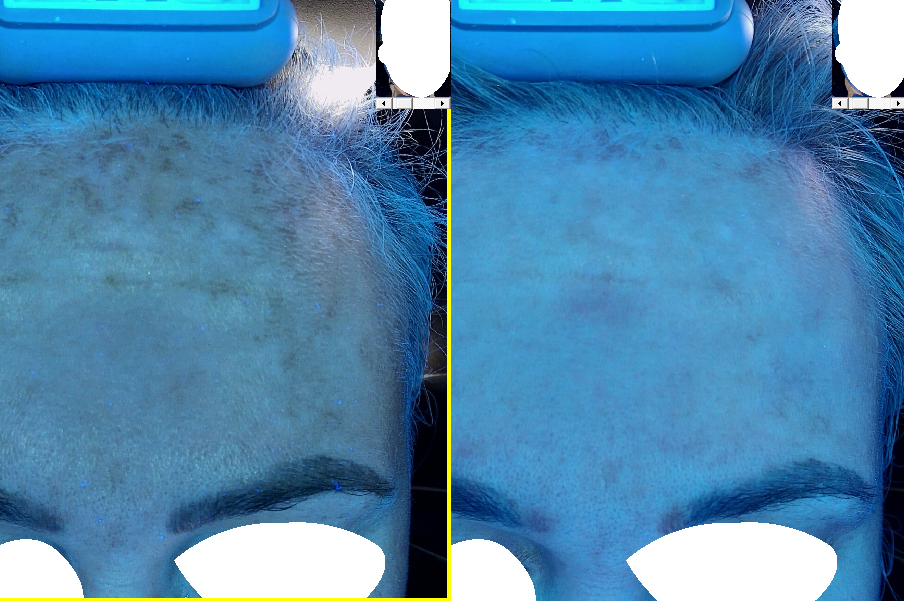
The clinic's archive photographs and videos show individual comparisons. Images alone cannot confirm the diagnosis, procedure count, timing, absence of cosmetics or another patient's expected outcome.

Laser treatment for facial pigmentation
How does it work?
The mechanism depends on the technology. Pigment lasers and IPL use the absorption of light by pigment; some fractional methods mainly target water in the tissues. Their depth and effects differ, so the device and settings are selected for the diagnosis and skin phototype.
Photographs of facial pigmentation


Video: comparison of forehead skin


Technologies and choice of method
Intense pulsed light (IPL) — a light-based method that may be used for selected pigment spots.
Nanosecond Q-switched and picosecond pigment lasers — different pulse-duration options whose suitability depends on the diagnosis.
Fractional lasers — treat separate microscopic areas of skin; they are not a universal solution for every type of pigmentation.
Thulium lasers — one option whose suitability is assessed individually.
Erbium lasers — effects and recovery depend on the particular technology and treatment mode.
Other methods, including topical treatments and peels — when indicated and with attention to irritation risk.
Having several devices does not determine the outcome by itself. The choice between laser, IPL and other methods depends on the diagnosis, skin phototype, pigment depth and risk of unwanted colour changes.
Potential benefits and limitations of laser treatment
Treatment can be directed at a selected area when the method suits the lesion.
Burns, increased or reduced pigmentation and scarring are possible; risk depends on the skin and procedure.
Redness, swelling, peeling and recovery time vary with the method.
Medical sources
Passeron et al. (2019). European Society of Laser in Dermatology position statement on laser treatment of hyperpigmented lesions.
Passeron et al. (2026). Global consensus on the management of melanin hyperpigmentation disorders.
ESLD publication in PubMed: Passeron et al., 2019.
Global consensus in PubMed: Passeron et al., 2026.
Combined treatments
Laser procedures may be combined with other methods when the diagnosis supports this approach. Dr Uskov's clinic selects protocols individually; combining technologies is not required for every patient and does not guarantee complete pigment clearance.

Choosing treatment
Before treatment, the doctor assesses the spots, skin phototype, possible causes and previous procedures. Dermoscopy and additional investigations are used when indicated. An uncertain or changing pigmented lesion requires diagnosis first; a biopsy with histological examination may be needed before a decision about cosmetic removal.
Based on the diagnostic data, a personal treatment plan is created, which may include several stages and types of procedures, as well as discussing prognosis, aftercare, restrictions, and prevention.


Results and recovery
The number of procedures, intervals and recovery depend on the diagnosis, treatment area, method and skin response. One standard course does not fit every pigment disorder. The doctor explains the expected benefit, aftercare and restrictions; sun protection is important, and maintenance treatment is prescribed when indicated. Pigmentation may persist or recur.

Facial hyperpigmentation has several causes. Suitable home skin care and sun protection can form part of treatment. The methods used at Dr. Uskov's clinic combine the latest laser technologies and individual protocols, with the expected benefit and risks assessed individually. Complete pigment clearance is not always possible. If you are looking for a professional approach to improving your skin, make an appointment with Dr Uskov kliinik for consultation and a personal treatment plan.
© 2025 Uskov Kliinik. All rights reserved.
This material is protected by copyright. Reproduction, copying or use of text, photos and videos in any form without prior written consent is prohibited.

