
Laser treatment of scars in children: modern possibilities and limitations
Updated: 15 hours ago
Scars in children are not just an aesthetic issue. Depending on the location and type of scar, they can cause itching, pain, limited mobility, increased skin sensitivity, or psychological discomfort.

Children may develop scars after injuries, surgery, burns, animal bites, chickenpox and other forms of skin damage.
Laser methods may be used to improve the colour, firmness and texture of pediatric scars. A method or combination is selected after examination; treatment does not eliminate the risk of damage to surrounding skin or other adverse effects.
Which types of scars can occur in children?
Children may present with several types of scars:
scars after surgical procedures
burn scars
post-traumatic scars
scars after animal bites
chickenpox scars
hypertrophic scars
red vascular scars
dense and itchy scars
scars that restrict skin mobility
Healing processes in children differ from those in adults.
How is scar treatment different in children?
Treatment planning takes account of the child's age and growth, skin condition, scar type and healing characteristics. Age alone cannot predict how a scar will respond.
When treating a child, the clinician considers safety, discomfort, recovery and tissue response. A series of gentler procedures may be selected in some cases. Each stage and its settings require individual assessment; staged treatment does not eliminate prolonged redness, pigmentation changes or discomfort.
Laser technologies a doctor may consider
A doctor may consider the following groups of methods according to the scar, skin condition and child's age. Indications, limitations and risks are discussed separately for each option:
vascular lasers to reduce redness
fractional lasers to improve skin texture
non-ablative lasers to stimulate tissue remodeling
erbium and CO2 lasers in gentle treatment modes
combined protocols for complex scars
additional methods for correcting vascular and pigment-related components.
When indicated, a doctor may combine methods targeting scar colour and texture. The combination and settings require individual assessment.
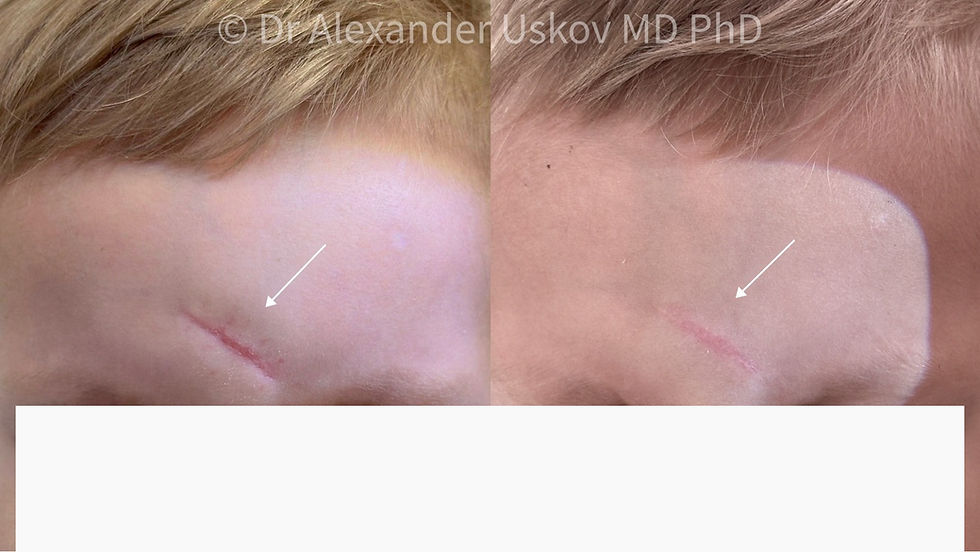
When is the best time to start scar treatment?
This depends on the type of scar and the stage of its formation.
Timing is decided after assessing skin healing, the scar's condition and maturation, symptoms and any effect on movement. There is no single starting time for every childhood scar; a doctor may recommend observation or treatment.
The decision is always made individually after evaluating:
the child’s age;
the type of scar;
how long the scar has been present;
the level of redness activity;
tendency toward hypertrophic scarring;
the location of the scar;
concerns reported by the child and parents.
Are the procedures painful?
Pain management, procedure length and any need for treatment in stages are discussed with the doctor beforehand. The choice depends on the child's age and health, the treatment area, method and clinical setting. Possible measures include skin cooling, local anaesthesia and shorter or staged procedures; suitability is assessed individually.
Discomfort and recovery time vary. One child's experience does not predict another's; pain management and aftercare are planned individually.
How many procedures may be needed?
If laser treatment is indicated, more than one procedure may be considered. The need and number depend on the scar's age, depth and size, redness, tissue firmness and individual healing characteristics.
Some scars respond well after the first few procedures, while more complex cases may require longer-term correction...

Is it possible to completely remove a scar?
Modern medicine approaches scar treatment as an improvement in scar quality rather than its “complete erasure.” The goal of treatment is usually to make the scar less noticeable, more flexible and mobile and less uncomfortable for the child.
Results are always individual and depend on many factors, including the skin’s healing characteristics.
What to look for when choosing a clinic
When treating scars in children, the following factors are especially important:
experience specifically with pediatric scars;
availability of different laser technologies;
understanding of the characteristics of children’s skin;
use of gentle treatment protocols;
individualized parameter selection;
realistic assessment of expected results.
Combined laser protocols make it possible to adapt treatment more flexibly to different scar types and the child’s age.
Conclusion
Laser scar treatment in children is a specialized area of modern laser medicine that requires a careful approach, an understanding of healing processes, and individualized treatment planning.
Treatment may reduce a scar's visibility or associated symptoms, but the degree of improvement cannot be guaranteed beforehand. Expected benefits, risks and the need for treatment are discussed with the doctor in light of the child's needs.
Before treatment, discuss sun protection, possible adverse effects and care after the procedure. The doctor tailors recommendations to the child; follow the instructions provided.
Further reading from the American Academy of Dermatology:


