
Raised, firm C-section scar: why is it growing, and what can you do?
If your C-section scar is becoming raised, firm or increasingly itchy, have it assessed by a doctor. It is not necessarily a keloid, and laser resurfacing is not suitable for every case. The first step is to understand what is happening in the tissue.
Gradual thickening of a healed scar and inflammation of a surgical wound are different problems. This distinction affects both the urgency of assessment and the choice of treatment.

Why does a scar become firm and raised?
After surgery, the body repairs the area with connective tissue. When too much forms, the scar may rise above the skin, feel hard and cause itching or tightness.
Individual susceptibility, tissue tension, inflammation and the course of healing affect scarring. A raised scar does not prove that you cared for yourself incorrectly or that the operation was poorly performed. 1
Some firmness and pinkness in a young scar do not automatically indicate abnormal scarring. The direction of change matters: is it becoming softer and calmer, or continuing to thicken and cause symptoms?
Hypertrophic scar or keloid: what is the difference?
A hypertrophic scar is raised but stays within the original wound. It may partly flatten over time.
A keloid grows beyond the original injury and can continue enlarging. Its tendency to regrow affects treatment choices. 1
Redness or itching alone cannot distinguish the two. Not every raised scar is a keloid; diagnosis requires an examination.
When is assessment urgent?
Fever, pus, wound separation, rapidly spreading redness or increasing pain require urgent assessment because they may indicate a healing complication. 2
If the skin has closed but the scar gradually grows, becomes firmer, itches or restricts movement, arrange a routine consultation without waiting a year.
A separate lump or painful swelling near the incision also needs assessment: not every lump here is scar tissue. Further investigation may be recommended.
Can cream or silicone sheets be enough?
On fully healed skin, silicone products may form part of the plan. Use them regularly as instructed, watch for irritation and assess changes over time.
However, the evidence is limited. A Cochrane review does not support promising substantial improvement to every patient. 3
An ordinary moisturiser may ease dryness but is not equivalent to treating a growing scar. If the area becomes thicker or more painful, do not spend months switching creams without medical assessment.
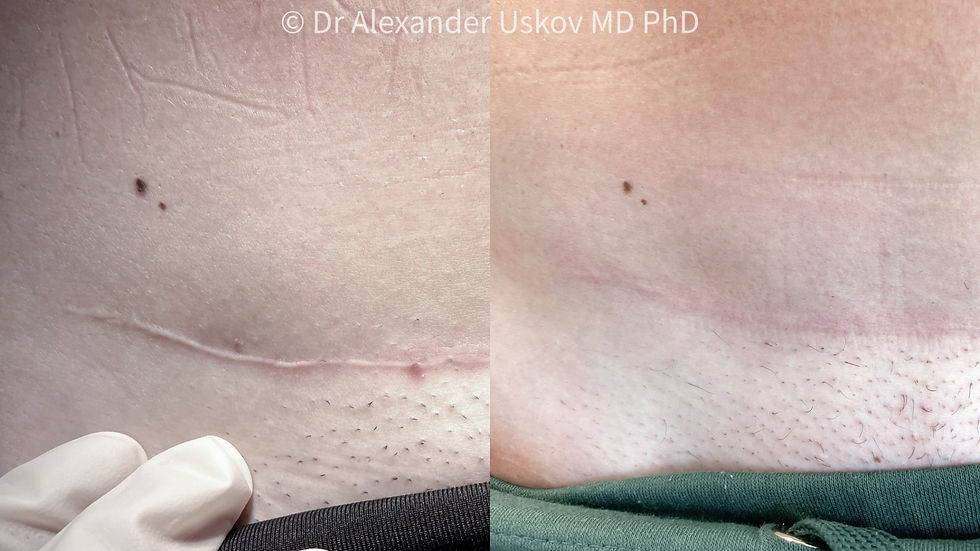
How is treatment selected?
The doctor examines height, colour, firmness, borders, growth activity and symptoms. A similar appearance does not always call for the same procedure.
Addressing excess scar tissue. In selected cases, an injection into the scar, such as a corticosteroid, may be discussed. Skin thinning, pigment changes and other adverse effects are possible, so the regimen must be selected by a clinician. 4
Addressing redness and tissue quality. Laser methods may be part of a plan, but their targets differ. Reducing redness is not the same as reducing thickness, and improving the surface may not resolve deeper tethering.
Combining methods and monitoring. Treatments may be staged. Sometimes scar activity is addressed before surface correction is considered. The next step depends on the tissue response.
Can a laser make a keloid worse?
Yes, an unsuitable method or excessive injury can worsen scarring. An actively growing keloid should not automatically be treated like a flat, mature surgical scar.
The 2022 guideline on laser therapy of the skin advises against fractional ablative treatment of active keloids. 5 Some other laser approaches may nevertheless form part of an individual combined treatment plan.
A Cochrane review highlights uncertainty in the evidence for several laser treatments of hypertrophic scars and keloids. This supports discussing the benefits and risks of a particular approach rather than promising universal “laser removal”. 6
Does the scar need to be cut out?
Not always. Keloid excision needs particular caution because the scar may grow back. If surgery is considered, a plan to reduce recurrence should be discussed alongside it. 4
An indented scar or a substantial change in abdominal contour may present a different problem from a raised surface scar. Your doctor can explain whether skin treatment is appropriate or another specialist is needed.

Frequently asked questions
Does itching mean the scar is growing?
Not necessarily. Different conditions can cause itching. The combination of symptoms and change over time matters; avoid scratching the skin.
Can an old raised scar become less noticeable?
Sometimes. Options depend on the diagnosis and tissue condition. Realistic goals include reducing height, firmness, redness and discomfort; complete disappearance cannot be guaranteed.
How many sessions will I need?
There is no universal course. The plan is reviewed according to the scar's response. Changes are assessed after recovery, and a tendency to form keloids may require longer follow-up.
Consultation at Dr USKOV Kliinik in Tallinn
Dr Alexander Uskov assesses surgical scars and selects an individual plan based on activity, symptoms and previous treatment. Laser methods are used when indicated and may be combined with other approaches.
Bring your C-section date, details of previous procedures and medicines, and photographs showing change. Mention unusual scars after other operations and breastfeeding. Options, recovery, risks and cost are discussed after examination.
Read about timing in C-section scar: when should treatment start, and do you need to wait a year?. Laser options are explained in our main article about C-section scar treatment.
Author: Dr Alexander Uskov, MD, PhD. Dr USKOV Kliinik, Tallinn, Estonia.

